
Original price was: ₹20,000.00.₹18,000.00Current price is: ₹18,000.00. accreditation fees
Description
As is widely known, UKJAS Accreditation Pvt. Ltd conducting various technical courses inviting interested personnel/technocrats for enhancing & fine-tuning of the skill.
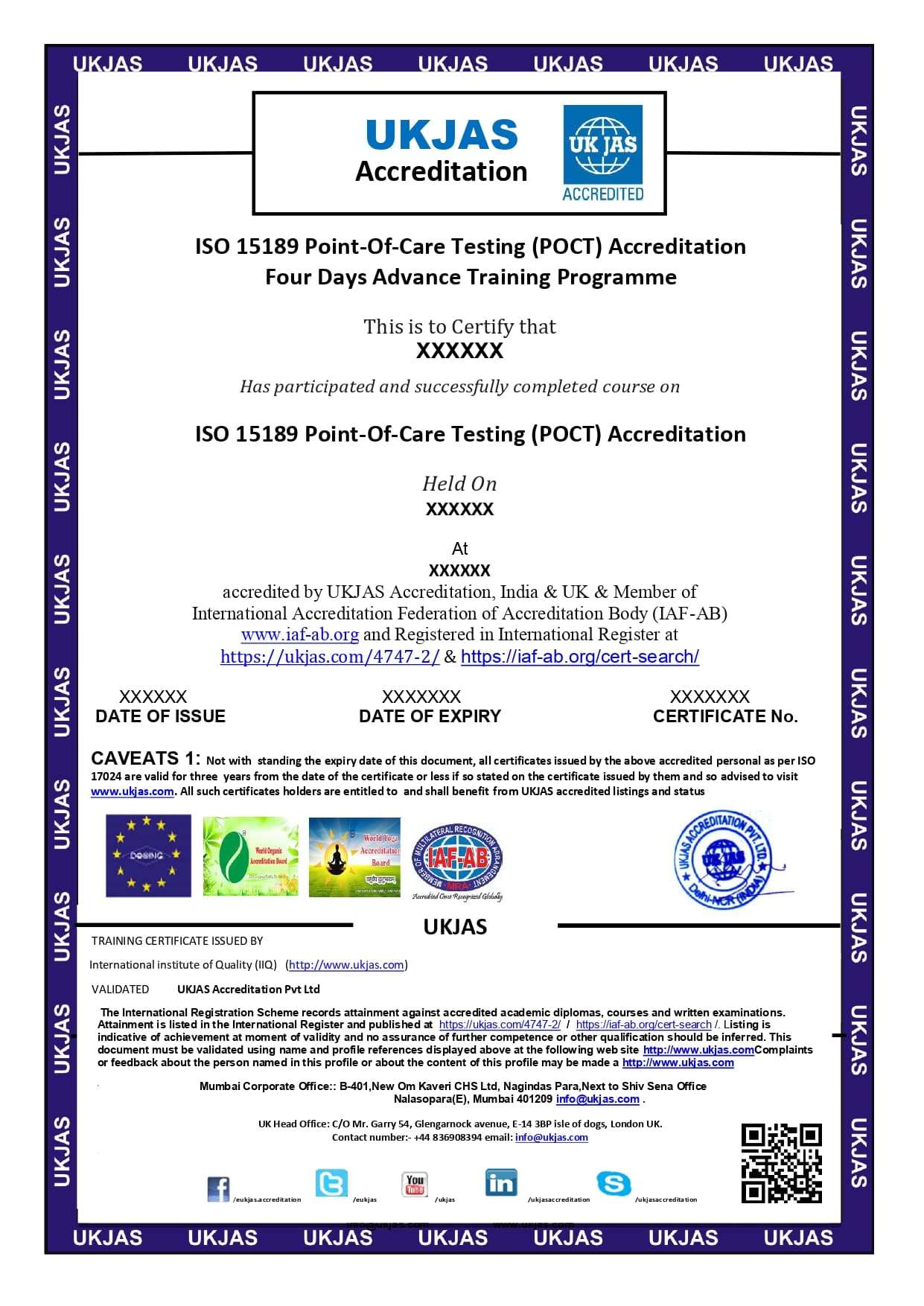
UKJAS Accreditation Pvt. Ltd organizing 4 Days Advance Training Programe Classroom & online Training course for ISO 15189 Point-Of-Care Testing (POCT) Accreditation
ISO INTRODUCTION
The standards published by ISO undergo changes periodically, to reflect the best-suited practices over the changing times. ISO series of standards
For a business unit to successfully set up and ISO 15189 Point-Of-Care Testing (POCT) Accreditation or get maximum benefits from an established management system, auditors within the organization have to be trained to assess the system against ISO 15189 Point-Of-Care Testing (POCT) Accreditation They must also be able to assess their suppliers required management system to support own Quality Initiative.
To increase professionalism, quality auditors also seek formal registration with the IAF-AB (UK) one of the prerequisites for such registration requires the quality auditors and practitioners to successfully complete an IAF-AB (UK) approved auditor training.
- OBJECTIVE OF THE COURSE:
The objective of the course is to illustrate the importance of the 4 Days Advance Training Programe role, skills and competency in bearing the ultimate responsibility for the effective performance of the audit team. A practical and intensive course for training quality professionals to External, Internal and manage third and second party audits of a ISO 15189 Point-Of-Care Testing (POCT) Accreditation Course describes how to plan and perform an audit, report findings, conduct opening and closing meetings and establish follow-up action. You will understand by the end of the course how regular auditing by an audit team directed by a competent internal auditor is the foundation of an effective ISO 15189 Point-Of-Care Testing (POCT) Accreditation On completion of the course you will have the necessary skills and the experience to Internal Audit and manage your own audits. The learning process will include a
Series of tutorials, exercises, culminating in both practical and written examination. Delegates will be supplied with a bound set of comprehensive course notes.
- COURSE CONTENTS:
- Introduction to ISO 15189 Point-Of-Care Testing (POCT) Accreditation Vocabulary & understanding definitions
- Introduction to ISO 15189 Point-Of-Care Testing (POCT) Accreditation Need for Internal Quality Audits
- Auditing Techniques
- Conducting Internal Quality Audits
- Course Examination with minimum 50% passing marks.
Day 1: Introduction to ISO 15189 and POCT Concepts
Session 1: Overview of ISO 15189
- Introduction to ISO 15189
- Definition and scope of ISO 15189.
- Importance of accreditation in medical laboratories, specifically for POCT.
- Key Terminology
- Definitions of critical terms related to POCT and laboratory accreditation.
Session 2: Understanding Point-of-Care Testing (POCT)
- What is POCT?
- Definition and examples of POCT applications.
- Benefits and challenges associated with POCT.
- Regulatory and Accreditation Landscape
- Overview of regulations and standards impacting POCT, including national and international perspectives.
Session 3: Core Principles of ISO 15189
- Structure of ISO 15189
- Breakdown of the standard’s structure and its key sections.
- Quality Management System (QMS) Requirements
- Overview of QMS elements and their application in medical laboratories.
Session 4: Stakeholders in POCT
- Roles and Responsibilities
- Identifying key stakeholders involved in POCT, including clinicians, laboratory staff, and patients.
- Collaboration and Communication
- Importance of effective communication among stakeholders for successful POCT implementation.
Group Activity:
- Participants engage in group discussions to identify the current status and challenges of POCT in their respective organizations.
Day 2: Implementing ISO 15189 in POCT
Session 5: Developing a Quality Management System for POCT
- Designing a QMS for POCT
- Principles of establishing a robust QMS tailored for POCT.
- Document Control and Management
- Importance of proper documentation and record-keeping for compliance with ISO 15189.
Session 6: Competence and Training of Personnel
- Personnel Competence Requirements
- Understanding the necessary qualifications and training for POCT personnel.
- Developing a Competence Framework
- Strategies for ongoing training and assessment of staff competencies.
Session 7: Pre-analytical, Analytical, and Post-analytical Processes
- Understanding the Testing Process
- Overview of the pre-analytical, analytical, and post-analytical phases specific to POCT.
- Quality Control and Assurance
- Implementing quality control measures to ensure accurate and reliable test results.
Session 8: Equipment and Maintenance
- Selecting Appropriate POCT Devices
- Criteria for choosing suitable POCT devices for various applications.
- Maintenance and Calibration
- Importance of regular maintenance and calibration of POCT devices.
Group Activity:
- Participants work in groups to develop a draft QMS framework for POCT, including documentation strategies.
Day 3: Accreditation Process and Internal Audits
Session 9: Preparing for ISO 15189 Accreditation
- Accreditation Process Overview
- Steps involved in obtaining ISO 15189 accreditation for POCT.
- Conducting Gap Analysis
- Techniques for performing gap analysis to identify areas needing improvement.
Session 10: Internal Audits in POCT
- Internal Audit Principles
- Overview of internal audit processes specific to POCT.
- Preparing for Audits
- Best practices for preparing for internal and external audits.
Session 11: Management Review and Continuous Improvement
- Conducting Management Reviews
- Importance of regular management reviews in maintaining an effective QMS.
- Continuous Improvement Practices
- Strategies for fostering a culture of continuous improvement in POCT.
Session 12: Handling Non-conformities and Complaints
- Identifying Non-conformities
- Techniques for identifying and documenting non-conformities in POCT processes.
- Managing Complaints
- Establishing processes for handling complaints from patients and stakeholders.
Group Activity:
- Participants engage in case studies to analyze real-world examples of successful and unsuccessful POCT accreditation processes.
Day 4: Case Studies, Future Trends, and Course Review
Session 13: Case Studies in ISO 15189 and POCT
- Learning from Experience
- Examination of successful ISO 15189 implementations in POCT settings.
- Best Practices for Accreditation
- Identifying best practices and lessons learned from case studies.
Session 14: Future Trends in POCT and Accreditation
- Emerging Technologies and Innovations
- Overview of emerging trends and technologies in POCT (e.g., mobile health, telemedicine).
- Impact of Regulatory Changes
- Anticipating future regulatory changes and their impact on POCT practices.
Session 15: Course Review and Key Takeaways
- Recap of Key Concepts
- Summary of major topics covered throughout the training.
- Participants reflect on their learning and how it applies to their organizations.
- Planning for Implementation
- Developing personal action plans for implementing ISO 15189 standards in POCT within participants’ organizations.
Session 16: Certification of Completion
- Issuing Certificates
- Participants receive certificates of completion for the training program.
- Networking Opportunities
- Facilitating networking among participants for future collaboration and support.
Learning Outcomes:
By the end of this training, participants will:
- Understand ISO 15189 standards and their application in point-of-care testing.
- Develop and implement effective quality management systems for POCT.
- Conduct internal audits and prepare for accreditation assessments.
- Manage non-conformities and complaints effectively.
- Identify emerging trends and future challenges in the field of POCT.
Delivery Method:
- Classroom Training: Interactive lectures, group discussions, case studies, and hands-on activities.
- Distance Learning: Virtual presentations, downloadable resources, quizzes, and online discussions.
Materials Provided:
- Comprehensive course manual covering ISO 15189 requirements, quality management principles, and best practices in POCT.
- Templates for audit checklists, quality management documentation, and complaint management processes.
- Certificate of completion for participants.
This training program aims to equip participants with advanced knowledge and practical skills necessary for effectively implementing ISO 15189 standards in point-of-care testing environments, thereby enhancing the quality and reliability of healthcare services provided to patients.
For detail of contents refer our website at www.UKJAS.in
- WHO SHOULD ATTEND:
1) All employees whose work responsibility directly affects ISO 15189 Point-Of-Care Testing (POCT) Accreditation
2) Those individuals willing to take up external auditing as a future profession by becoming an independent auditor.
3) Those who intend to enroll themselves to IAF-AB (UK) Registration Schemes of ISO 15189 Point-Of-Care Testing (POCT) Accreditation
4) Management Representatives responsible for effective implementation and execution of ISO 15189 Point-Of-Care Testing (POCT) Accreditation
- FACILITIES:
All facility for delegates covering lecture hall, tea and lunch will be arranged by Client or if you are attending the course at UKJAS Offices. UKJAS institute will arrange the above facility.
- COURSE DETAILS:
Detail program of every days training course will be sent / given on the first day to the delegates on registration.
- DURATION:
Four days Advance Training program for ISO 15189 Point-Of-Care Testing (POCT) Accreditation [Timings: 10.00 am to 6.00 pm]
FEES:
- 4 Days Advance Training program of ISO 15189 Point-Of-Care Testing (POCT) Accreditation and any other program is Rs 18000+18%GST Payment should be made by Cheque / DD in favor of “UKJAS Accreditation Pvt.Ltd, Mumbai.
Related products
-
Sale!
ISO 19650-2 ACCREDITATION FOR BUILDING INFORMATION MODELING PROGRAMME TECHNICAL SERVICES
Original price was: ₹20,000.00.₹18,000.00Current price is: ₹18,000.00. accreditation fees Add to cart -
Sale!
IQIPS –Improving Quality In Physiological Services Accreditation (IQIPS)
Original price was: ₹20,000.00.₹18,000.00Current price is: ₹18,000.00. accreditation fees Add to cart -
Sale!
ISO 44001:2017 COLLABRATIVE BUSINESS RELENATIONSHIP MANAGEMENT SYSTEMS TECHNICAL SERVICES
Original price was: ₹20,000.00.₹18,000.00Current price is: ₹18,000.00. accreditation fees Add to cart -
Sale!
ISO/IEC 17065 ACCREDITATION FOR PRODUCT CERTIFICATION BODY
Original price was: ₹20,000.00.₹18,000.00Current price is: ₹18,000.00. accreditation fees Add to cart