
₹8,000.00 Original price was: ₹8,000.00.₹5,500.00Current price is: ₹5,500.00. accreditation fees
Description
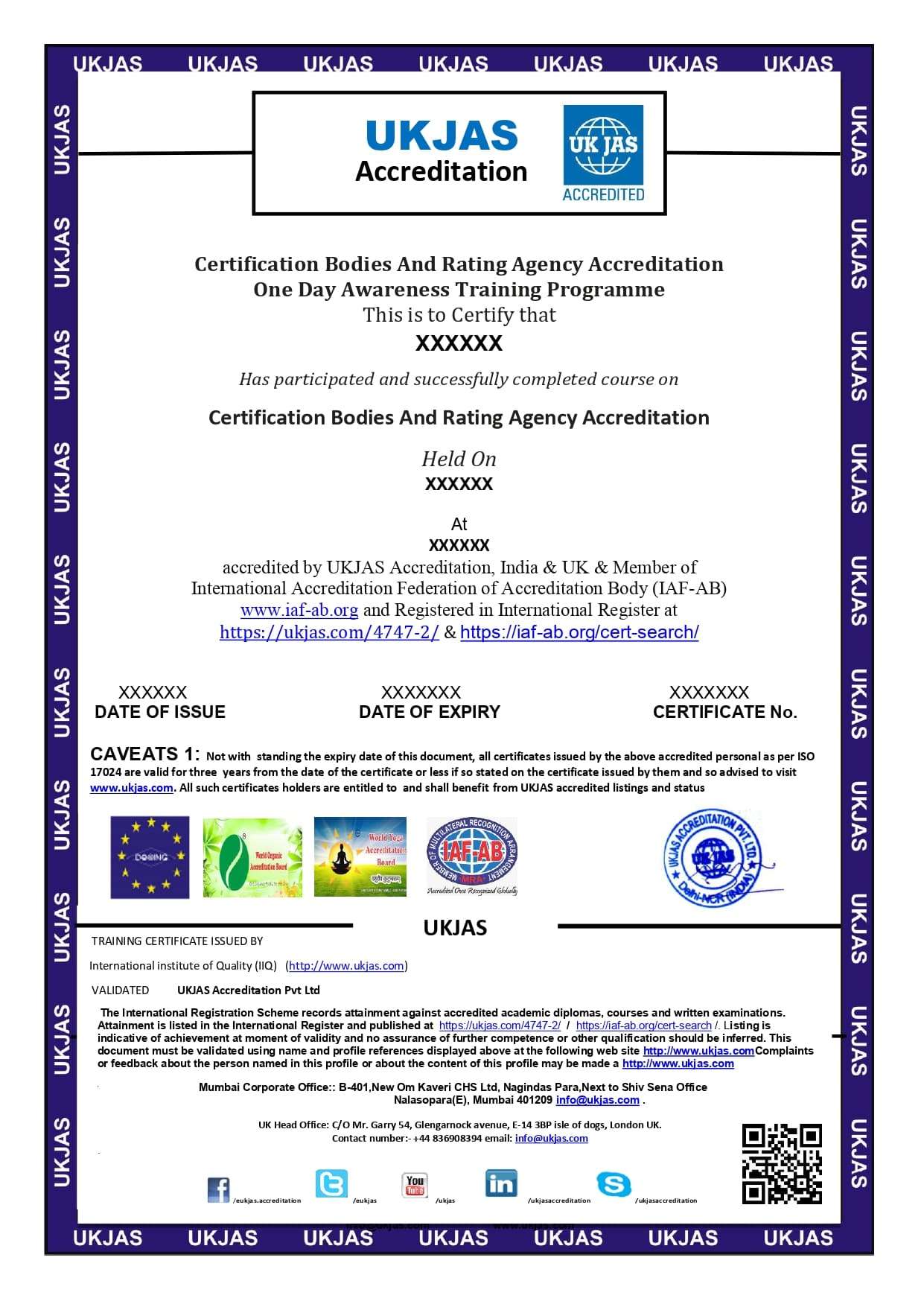
Certification Bodies and Rating Agency Accreditation
Concept, Framework, Standards, Process, and Importance
1. Introduction on Certification Bodies and Rating Agency Accreditation
In today’s globalized and highly regulated environment, confidence in certification, inspection, validation, verification, and rating outcomes is critical. Organizations, governments, regulators, investors, and consumers rely on certification bodies (CBs) and rating agencies to provide independent, impartial, and technically competent evaluations. However, trust in these bodies does not arise automatically. It is established through a structured and internationally recognized mechanism known as accreditation.
Accreditation is the formal recognition that a certification body or rating agency is competent, impartial, and consistently operating in accordance with applicable standards. Accreditation ensures that certificates, ratings, and conformity assessment results are credible, reliable, and globally accepted.
This document explains the concept of accreditation, its relevance to certification bodies and rating agencies, applicable international standards, accreditation processes, and the overall importance of accreditation in maintaining quality, transparency, and confidence in conformity assessment activities.
2. Understanding Certification Bodies and Rating Agency Accreditation
2.1 Certification Bodies and Rating Agency Accreditation
A Certification Body (CB) is an independent organization that assesses and certifies management systems, products, services, processes, or personnel against specified standards or schemes.
Common examples include certification for:
-
ISO 9001 (Quality Management Systems)
-
ISO 14001 (Environmental Management Systems)
-
ISO 45001 (Occupational Health & Safety)
-
ISO 22000 / FSSC 22000 (Food Safety)
-
ISO/IEC 27001 (Information Security)
-
Personnel certification (e.g., auditors, inspectors)
-
Product and service certifications
Certification bodies conduct audits, evaluations, and surveillance activities and issue certificates as evidence of conformity.
2.2 Rating Agency Accreditation
Rating agencies assess and grade organizations, products, projects, or systems based on defined performance criteria. Unlike certification, ratings usually indicate levels of performance or maturity, rather than simple conformity.
Examples include:
-
Sustainability and ESG rating agency accreditation
-
Green building rating systems
-
Energy efficiency ratings
-
Healthcare quality ratings
-
Infrastructure and safety ratings
-
Environmental and social responsibility ratings
Ratings influence:
-
Investment decisions
-
Regulatory approvals
-
Public trust and reputation
-
Market competitiveness
Because ratings strongly impact stakeholders, credibility and transparency of rating agencies are essential.
3. What Is Accreditation?
Accreditation is a third-party attestation by an authoritative body (called an Accreditation Body) that a certification body or rating agency:
-
Is technically competent
-
Operates impartially and independently
-
Applies standards consistently
-
Maintains a robust management system
-
Produces valid, reliable, and repeatable results
Accreditation is typically granted by national or international accreditation bodies such as:
-
NABCB (India)
-
UKAS (United Kingdom)
-
ANAB (USA)
-
JAS-ANZ (Australia–New Zealand)
-
DAkkS (Germany)
-
CNAS (China)
These bodies often operate under global cooperation frameworks such as ILAC (International Laboratory Accreditation Cooperation) and IAF (International Accreditation Forum).
4. Why Accreditation Is Essential
4.1 Trust and Credibility
Accreditation provides confidence that certificates and ratings are:
-
Based on objective evidence
-
Issued by competent professionals
-
Free from conflicts of interest
Without accreditation, certificates and ratings may be questioned or rejected.
4.2 International Recognition
Accredited certification bodies and rating agencies benefit from mutual recognition arrangements (MRAs/MLAs) under IAF and ILAC, enabling:
-
Global acceptance of certificates
-
Reduced duplication of audits
-
Easier market access
4.3 Regulatory and Contractual Acceptance
Many regulators, governments, and procurement authorities:
-
Mandate accredited certification
-
Recognize only accredited ratings
-
Require conformity assessment by accredited bodies
4.4 Risk Reduction
Accreditation minimizes risks associated with:
-
Incorrect certification decisions
-
Inconsistent ratings
-
Legal disputes
-
Reputational damage
5. Key International Standards for Accreditation
5.1 ISO/IEC 17021-1 – Certification Bodies for Management Systems
Applies to certification bodies certifying:
-
Quality, environment, OH&S, food safety, energy, information security, etc.
Key requirements include:
-
Impartiality and independence
-
Auditor competence
-
Audit process control
-
Confidentiality
-
Decision-making integrity
5.2 ISO/IEC 17065 – Product, Process, and Service Certification
Used for certification bodies certifying:
-
Products
-
Services
-
Processes
-
Schemes such as eco-labels or compliance marks
5.3 ISO/IEC 17024 – Personnel Certification Bodies
Applicable to bodies certifying individuals such as:
-
Auditors
-
Inspectors
-
Engineers
-
Safety professionals
5.4 ISO/IEC 17020 – Inspection Bodies
Relevant when certification bodies or rating agencies also conduct inspection activities.
5.5 ISO/IEC 17029 – Validation and Verification Bodies
Important for:
-
Greenhouse gas verification
-
Sustainability claims
-
Environmental and ESG validation
5.6 ISO/IEC 17011 – Accreditation Bodies
Defines how accreditation bodies themselves must operate, ensuring:
-
Independence
-
Transparency
-
Competence
-
Global harmonization
6. Accreditation of Rating Agencies
Unlike traditional certification bodies, rating agencies often operate under scheme-specific or sector-specific accreditation frameworks. However, accreditation principles remain the same.
6.1 Core Accreditation Expectations for Rating Agency accreditation
-
Clear and transparent rating methodology
-
Defined scoring criteria
-
Qualified and competent assessors
-
Independence from rated entities
-
Data integrity and confidentiality
-
Consistent application of rating rules
-
Appeals and complaints mechanism
6.2 Alignment with International Standards
Many rating agencies align with:
-
ISO/IEC 17021-1 (where audits are involved)
-
ISO/IEC 17029 (for validation/verification)
-
ISO 17065 (for scheme-based ratings)
-
Sector-specific accreditation programs
7. Accreditation Process for Certification Bodies and Rating Agency Accreditation
7.1 Application
The organization submits:
-
Scope of accreditation
-
Management system documentation
-
Procedures and policies
-
Competence records
-
Scheme rules (for rating agencies)
7.2 Document Review
Accreditation body reviews:
-
Compliance with applicable ISO standards
-
Impartiality framework
-
Risk management approach
-
Decision-making process
7.3 Office Assessment
Assessment of:
-
Management system implementation
-
Competence management
-
Records and controls
-
Certification or rating decisions
7.4 Witness Assessment
Accreditation assessors observe:
-
Audits conducted by certification bodies
-
On-site assessments by rating agencies
-
Evaluation consistency and professionalism
7.5 Nonconformity Closure
Identified gaps must be:
-
Analyzed
-
Corrected
-
Supported with objective evidence
7.6 Accreditation Decision
Based on assessment results, accreditation may be:
-
Granted
-
Deferred
-
Limited in scope
-
Denied (in rare cases)
7.7 Surveillance and Re-assessment
Accreditation is not permanent. Ongoing:
-
Annual surveillance
-
Periodic reassessment
-
Witness audits
ensure continued compliance.
8. Impartiality and Independence
One of the most critical accreditation requirements is impartiality.
Certification bodies and rating agencies must:
-
Identify conflicts of interest
-
Separate consulting from certification/rating
-
Ensure independent decision-making
-
Maintain impartiality committees
Failure to maintain impartiality can result in:
-
Suspension or withdrawal of accreditation
-
Loss of market credibility
9. Competence Management
Accredited bodies must demonstrate:
-
Defined competence criteria
-
Qualification and experience requirements
-
Initial and ongoing training
-
Performance monitoring
-
Authorization and re-authorization processes
Competence is assessed not only technically but also in:
-
Ethics
-
Communication
-
Professional judgment
10. Benefits of Accreditation
10.1 For Certification Bodies and Rating Agency Accreditation
-
Enhanced credibility and market trust
-
International recognition
-
Competitive advantage
-
Structured and consistent operations
-
Reduced legal and reputational risks
10.2 For Clients and Stakeholders
-
Confidence in certification and ratings
-
Reliable decision-making support
-
Reduced need for multiple assessments
-
Transparency and fairness
10.3 For Regulators and Society
-
Improved compliance and governance
-
Protection of public interest
-
Improved quality, safety, and sustainability outcomes
11. Challenges in Accreditation
-
High initial investment
-
Continuous compliance requirements
-
Maintaining competence in evolving sectors
-
Managing impartiality in competitive markets
-
Alignment with multiple international schemes
Despite these challenges, accreditation remains the gold standard for credibility.
12. Conclusion
Accreditation of certification bodies and rating agencies plays a fundamental role in ensuring trust, consistency, and integrity in conformity assessment and performance evaluation activities. In an era where certificates and ratings influence regulatory approvals, investment decisions, sustainability commitments, and public confidence, accreditation acts as the ultimate assurance mechanism.
By complying with internationally recognized standards such as ISO/IEC 17021, 17065, 17024, and 17029, and operating under the oversight of competent accreditation bodies, certification bodies and rating agencies demonstrate their commitment to quality, impartiality, and excellence.
Ultimately, accreditation protects stakeholders, strengthens markets, and contributes to safer, more transparent, and more sustainable systems worldwide.
For more details visit our website at www.iaf-ab.org
Related products
-
Sale!
ISO 19443 ACCREDITATION FOR NUCLEAR SECTOR SUPPLYING PRODUCT AND SERVICES
₹8,000.00Original price was: ₹8,000.00.₹5,500.00Current price is: ₹5,500.00. accreditation fees Add to cart -
Sale!
ISO/IEC 17024 FOR INDEPENDENT TRAINING INSTITUTE ACCREDITATION TECHNICAL SERVICES
₹8,000.00Original price was: ₹8,000.00.₹5,500.00Current price is: ₹5,500.00. accreditation fees Add to cart -
Sale!
ISO/IEC 17065 ACCREDITATION FOR PRODUCT CERTIFICATION BODY
₹8,000.00Original price was: ₹8,000.00.₹5,500.00Current price is: ₹5,500.00. accreditation fees Add to cart -
Sale!
ISO/IEC 17043 PROFICIENCY TESTING PROVIDER ACCREDITATION TECHNICAL SERVICES
₹8,000.00Original price was: ₹8,000.00.₹5,500.00Current price is: ₹5,500.00. accreditation fees Add to cart