
Original price was: ₹30,000.00.₹25,000.00Current price is: ₹25,000.00. accreditation fees
Description
As is widely known, UKJAS Accreditation Pvt. Ltd conducting various technical courses inviting interested personnel/technocrats for enhancing & fine-tuning of the skill.
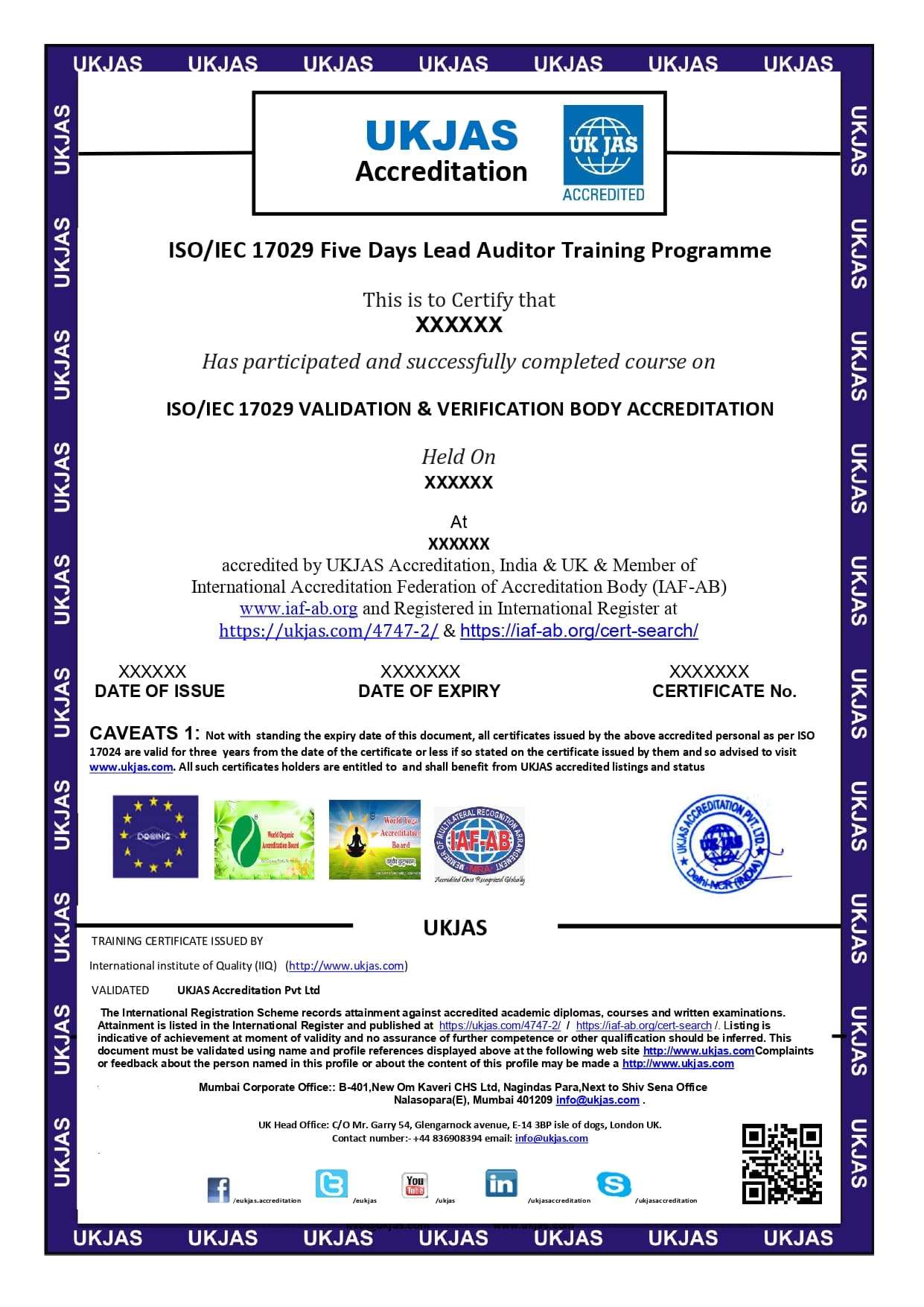
UKJAS Accreditation Pvt. Ltd organizing 5 Days Lead Auditor Training Programe Classroom & online Training course for ISO/IEC 17029 VALIDATION & VERIFICATION BODY ACCREDITATION.
- ISO INTRODUCTION
The standards published by ISO undergo changes periodically, to reflect the best-suited practices over the changing times. ISO series of standards
For a business unit to successfully set up and ISO/IEC 17029 VALIDATION & VERIFICATION BODY ACCREDITATION. Or get maximum benefits from an established management system, auditors within the organization have to be trained to assess the system against ISO/IEC 17029 VALIDATION & VERIFICATION BODY ACCREDITATION. They must also be able to assess their suppliers required management system to support own Quality Initiative.
To increase professionalism, quality auditors also seek formal registration with the IAF-AB (UK) one of the prerequisites for such registration requires the quality auditors and practitioners to successfully complete an IAF-AB (UK) approved auditor training.
- OBJECTIVE OF THE COURSE:
The objective of the course is to illustrate the importance of the 5 Days Lead Auditor Training Programe role, skills and competency in bearing the ultimate responsibility for the effective performance of the audit team. A practical and intensive course for training quality professionals to External, Internal and manage third and second party audits of an ISO/IEC 17029 VALIDATION & VERIFICATION BODY ACCREDITATION. Course describes how to plan and perform an audit, report findings, conduct opening and closing meetings and establish follow-up action. You will understand by the end of the course how regular auditing by an audit team directed by a competent internal auditor is the foundation of an effective ISO/IEC 17029 VALIDATION & VERIFICATION BODY ACCREDITATION. On completion of the course you will have the necessary skills and the experience to Internal Audit and manage your own audits. The learning process will include a
Series of tutorials, exercises, culminating in both practical and written examination. Delegates will be supplied with a bound set of comprehensive course notes.
- COURSE CONTENTS:
- Introduction to ISO/IEC 17029 VALIDATION & VERIFICATION BODY ACCREDITATION. Vocabulary & understanding definitions
- Introduction to ISO/IEC 17029 VALIDATION & VERIFICATION BODY ACCREDITATION.
- Need for Internal Quality Audits
- Auditing Techniques
- Conducting Internal Quality Audits
- Course Examination with minimum 70% passing marks.
Day 1: Introduction to ISO/IEC 17029 and Auditing Fundamentals
- Session 1: Overview of ISO/IEC 17029
- Purpose and scope of ISO/IEC 17029
- Importance of validation and verification in various sectors
- Key definitions and terminology related to validation and verification
- Session 2: Structure of ISO/IEC 17029
- Key elements and clauses of the standard
- Understanding the differences between ISO/IEC 17029 and other related standards (e.g., ISO 9001, ISO/IEC 17020)
- Scope of accreditation for validation and verification bodies
- Session 3: Principles of Auditing
- Overview of auditing principles: integrity, objectivity, confidentiality, and competence
- The audit process: planning, conducting, reporting, and follow-up
- Roles and responsibilities of the lead auditor in the context of ISO/IEC 17029
- Workshop:
- Group discussion on the significance of ISO/IEC 17029 accreditation for validation and verification bodies and its impact on quality assurance.
Day 2: Management System Requirements
- Session 1: Management Requirements
- Understanding the management system structure as per ISO/IEC 17029
- Importance of a quality management system in validation and verification
- Document control and record-keeping requirements
- Session 2: Resource Management
- Personnel competence and training requirements for validation and verification staff
- Equipment and facility requirements for effective validation and verification processes
- Maintaining operational integrity and reliability in validation and verification activities
- Session 3: Risk Management
- Understanding risk management principles in validation and verification processes
- Tools and techniques for identifying and mitigating risks
- Integrating risk management into the management system of validation and verification bodies
- Workshop:
- Case studies on effective resource management and risk mitigation strategies in validation and verification bodies.
Day 3: Technical Requirements and Audit Planning
- Session 1: Technical Requirements
- Understanding the technical requirements specified in ISO/IEC 17029
- Methods and procedures for validation and verification
- Measurement uncertainty and its significance in validation and verification processes
- Session 2: Audit Planning
- Developing an effective audit plan tailored to validation and verification bodies
- Defining the audit scope, objectives, and criteria specific to ISO/IEC 17029
- Gathering and reviewing relevant documentation prior to the audit
- Session 3: Conducting the Audit
- Steps for conducting the audit: opening meeting, document review, evidence collection, interviews, and closing meeting
- Techniques for effective interviewing and evidence gathering in validation and verification contexts
- Workshop:
- Role-playing exercises to practice audit planning and conducting techniques specific to validation and verification bodies.
Day 4: Identifying Non-Conformities and Reporting
- Session 1: Identifying Non-Conformities
- Types of non-conformities and their implications in validation and verification processes
- Procedures for documenting and reporting audit findings
- Corrective action processes and preventive measures
- Session 2: Audit Reporting
- Key components of an effective audit report tailored to validation and verification bodies
- Techniques for communicating findings, conclusions, and recommendations clearly
- Importance of clarity and actionability in audit reporting
- Session 3: Follow-Up Procedures
- Monitoring corrective actions and assessing their effectiveness
- Follow-up audits and their role in maintaining accreditation
- Importance of feedback loops for continuous improvement in validation and verification practices
- Workshop:
- Group activity to develop a mock audit report based on hypothetical findings from a validation and verification audit.
Day 5: Practical Application and Certification
- Session 1: Best Practices and Challenges
- Review of best practices for maintaining ISO/IEC 17029 accreditation in validation and verification bodies
- Discussion on common challenges faced by validation and verification bodies in achieving and maintaining compliance
- Session 2: Mock Audits
- Conducting mock audits in small groups to simulate real-world scenarios for validation and verification bodies
- Peer feedback and discussion on findings and suggestions for improvement
- Session 3: Examination and Certification
- Written examination to assess understanding of course content
- Feedback session to discuss exam results and clarify doubts
- Issuance of certificates for successful participants
Additional Notes:
- Materials Provided:
- Course handbook and reference materials
- Copies of relevant ISO/IEC standards
- Access to online resources, templates, and discussion forums
- Assessment:
- Continuous assessment through participation in workshops and group activities
- Final examination to evaluate understanding of course content
Target Audience:
- Individuals involved in auditing, quality management, and accreditation processes, including managers and personnel from validation and verification bodies.
For detail of contents refer our website at www.ukjas.com
- WHO SHOULD ATTEND:
1) All employees whose work responsibility directly affects ISO/IEC 17029 VALIDATION & VERIFICATION BODY ACCREDITATION.
2) Those individuals willing to take up external auditing as a future profession by becoming an independent auditor.
3) Those who intend to enroll themselves to IAF-AB (UK) Registration Schemes of ISO/IEC 17029 VALIDATION & VERIFICATION BODY ACCREDITATION.
4) Management Representatives responsible for effective implementation and execution of ISO/IEC 17029 VALIDATION & VERIFICATION BODY ACCREDITATION.
FACILITIES:
All facility for delegates covering lecture hall, tea and lunch will be arranged by Client or if you are attending the course at UKJAS Offices. UKJAS institute will arrange the above facility.
- COURSE DETAILS:
Detail program of every days training course will be sent / given on the first day to the delegates on registration.
- DURATION:
five days Lead Auditor Training program for ISO/IEC 17029 VALIDATION & VERIFICATION BODY ACCREDITATION. [Timings: 10.00 am to 6.00 pm]
FEES:
5 Days Lead Auditor Training program of ISO/IEC 17029 VALIDATION & VERIFICATION BODY ACCREDITATION. and any other program is Rs 25000+18%GST Payment should be made by Cheque / DD in favor of “UKJAS Accreditation Pvt. Ltd, Mumbai
Related products
-
Sale!
ISO/IEC 17065 ACCREDITATION FOR PRODUCT CERTIFICATION BODY
Original price was: ₹30,000.00.₹25,000.00Current price is: ₹25,000.00. accreditation fees Add to cart -
Sale!
ISO 20387 ACCREDITATION OF BIO BANKS TO ENSURE BIOLOGICAL MATERIAL AND COLLECTIONS TECHNICAL SERVICES
Original price was: ₹30,000.00.₹25,000.00Current price is: ₹25,000.00. accreditation fees Add to cart -
Sale!
ISO/IEC 15189 ACCREN FOR PATHOLOGY LABORATORY TECHNICADITATIOL SERVICES
Original price was: ₹30,000.00.₹25,000.00Current price is: ₹25,000.00. accreditation fees Add to cart -
Sale!
ISO 19011 ACCREDITATION FOR COMPETENT PERSON REGISTRATION TECHNICAL SERVICES
Original price was: ₹30,000.00.₹25,000.00Current price is: ₹25,000.00. accreditation fees Add to cart