
Original price was: ₹12,000.00.₹10,500.00Current price is: ₹10,500.00. accreditation fees
Description
As is widely known, UKJAS Accreditation Pvt. Ltd conducting various technical courses inviting interested personnel/technocrats for enhancing & fine-tuning of the skill.
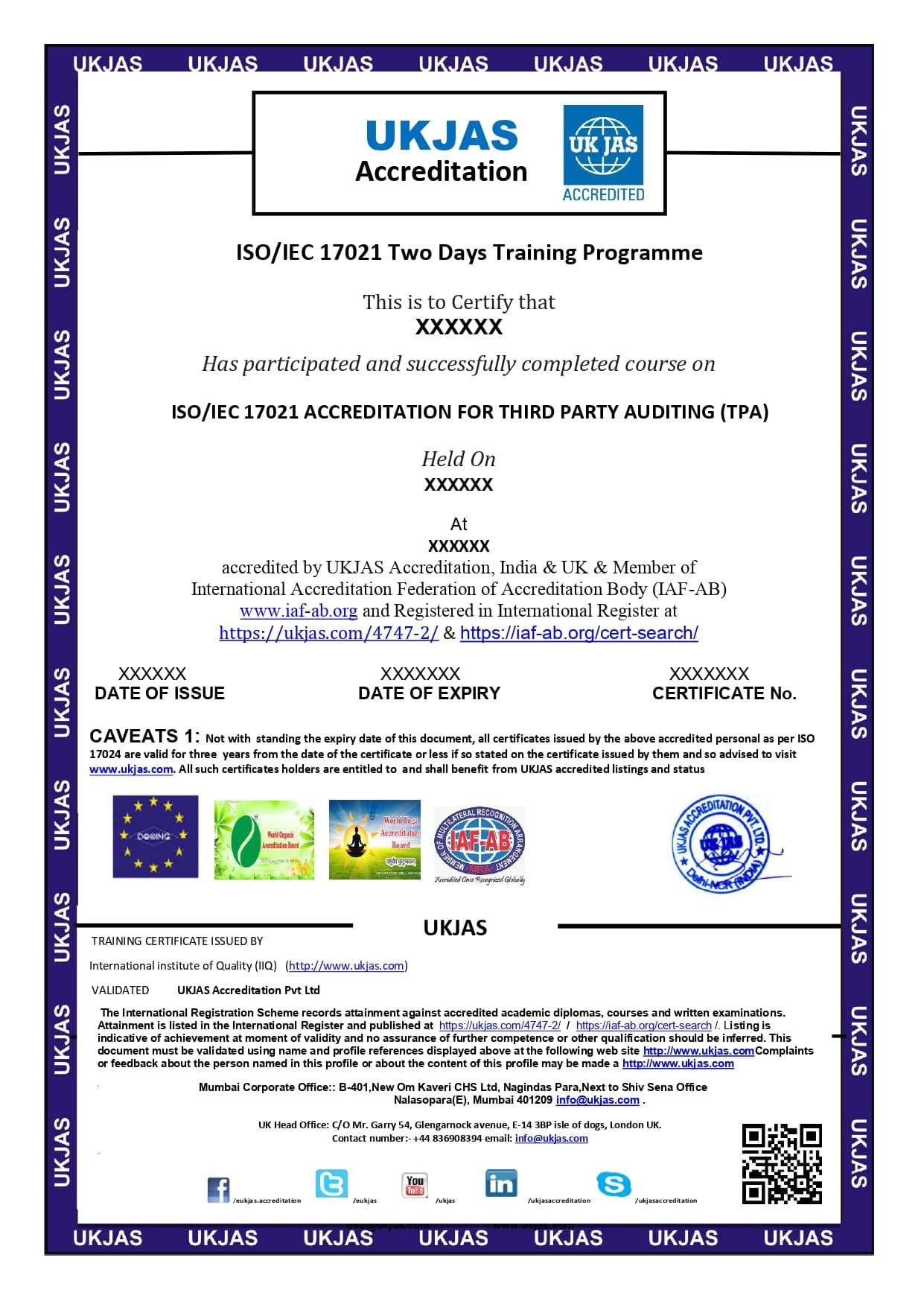
UKJAS Accreditation Pvt. Ltd organizing Internal Auditor Classroom & online Training course for ISO/IEC 17021 ACCREDITATION FOR THIRD PARTY AUDITING (TPA)
- ISO INTRODUCTION
The standards published by ISO undergo changes periodically, to reflect the best-suited practices over the changing times. ISO series of standards
For a business unit to successfully set up and ISO/IEC 17021 ACCREDITATION FOR THIRD PARTY AUDITING (TPA). or get maximum benefits from an established management system, auditors within the organization have to be trained to assess the system against ISO/IEC 17021 ACCREDITATION FOR THIRD PARTY AUDITING (TPA). They must also be able to assess their suppliers required management system to support own Quality Initiative.
To increase professionalism, quality auditors also seek formal registration with the IAF-AB (UK) one of the prerequisites for such registration requires the quality auditors and practitioners to successfully complete an IAF-AB (UK) approved auditor training.
- OBJECTIVE OF THE COURSE:
The objective of the course is to illustrate the importance of the Internal Auditors role, skills and competency in bearing the ultimate responsibility for the effective performance of the audit team. A practical and intensive course for training quality professionals to External, Internal and manage third and second party audits of an ISO/IEC 17021 ACCREDITATION FOR THIRD PARTY AUDITING (TPA). Course describes how to plan and perform an audit, report findings, conduct opening and closing meetings and establish follow-up action. You will understand by the end of the course how regular auditing by an audit team directed by a competent internal auditor is the foundation of an effective ISO/IEC 17021 ACCREDITATION FOR THIRD PARTY AUDITING (TPA). On completion of the course you will have the necessary skills and the experience to Internal Audit and manage your own audits. The learning process will include a
Series of tutorials, exercises, culminating in both practical and written examination. Delegates will be supplied with a bound set of comprehensive course notes.
- COURSE CONTENTS:
- Introduction to ISO/IEC 17021 ACCREDITATION FOR THIRD PARTY AUDITING (TPA) Vocabulary & understanding definitions
- Introduction to ISO/IEC 17021 ACCREDITATION FOR THIRD PARTY AUDITING (TPA).
- Need for Internal Quality Audits
- Auditing Techniques
- Conducting Internal Quality Audits
- Course Examination with minimum 50% passing marks.
Day 1: Overview and Core Requirements of ISO/IEC 17021
Session 1: Introduction to ISO/IEC 17021 Standards and Accreditation
- Overview of ISO/IEC 17021
- Purpose, scope, and importance of ISO/IEC 17021 in certification and third-party auditing
- Key principles of auditing: independence, competence, consistency, and impartiality
- Benefits of accreditation under ISO/IEC 17021
Session 2: Key Components and Structure of ISO/IEC 17021
- Structure of ISO/IEC 17021
- Examination of key clauses: general requirements, structural requirements, resource requirements, process requirements, and management system requirements
- Understanding the importance of compliance with each clause and its impact on audit credibility
- ISO/IEC 17021 Part 1 and Related Parts
- Detailed overview of Part 1 requirements for third-party auditing
- Brief introduction to related parts of the standard and their specific applications
Session 3: Impartiality and Confidentiality in Third-Party Auditing
- Impartiality and Conflict of Interest Management
- Ensuring objectivity in the audit process, managing conflicts of interest
- Roles and responsibilities in maintaining auditor impartiality
- Confidentiality and Information Security
- Establishing policies to safeguard client information and audit results
- Balancing transparency with confidentiality for client and stakeholder trust
Session 4: Competence Requirements for Auditing Personnel
- Competency Criteria for Auditors and Staff
- Qualifications, experience, and skills required for auditors under ISO/IEC 17021
- Training and continuous professional development for auditors
- Evaluating and Monitoring Auditor Performance
- Techniques for assessing and documenting auditor competency
- Performance appraisals, feedback, and ongoing improvement plans
Group Activity:
- Case study exercise: Participants review scenarios, evaluate potential conflicts of interest, and develop impartiality management strategies.
Day 2: Audit Process, Quality Management, and Accreditation Preparation
Session 5: Audit Process Requirements and Management
- Audit Planning and Preparation
- Developing audit plans, selecting audit teams, and ensuring adequate resources
- Pre-audit activities, such as client requirements review and document preparation
- Conducting the Audit and Documenting Findings
- Techniques for objective, evidence-based auditing in compliance with ISO/IEC 17021
- Handling audit findings, observations, and client communication effectively
- Audit Reporting and Record Management
- Structuring clear, transparent, and comprehensive audit reports
- Documentation control and traceability in line with ISO/IEC 17021 standards
Session 6: Management System Requirements and Continuous Improvement
- Establishing and Maintaining a Management System
- Essential components of a management system to support ISO/IEC 17021 compliance
- Setting measurable objectives, performance tracking, and review processes
- Continuous Improvement and Risk Management
- Tools and methods for continuous improvement in audit performance
- Identifying, assessing, and managing risks in the audit process to maintain credibility
Session 7: Handling Non-Conformities and Corrective Actions
- Identifying Non-Conformities and Root Cause Analysis
- Techniques for detecting and classifying non-conformities within the audit process
- Performing root cause analysis to prevent recurrence
- Corrective and Preventive Actions
- Developing and implementing corrective action plans
- Monitoring effectiveness and documenting actions taken
Session 8: Accreditation Process for ISO/IEC 17021 and Best Practices
- Steps to Achieve ISO/IEC 17021 Accreditation
- Accreditation application, submission, and assessment process
- Preparing for an external accreditation assessment, including pre-audit checklists and readiness evaluations
- Challenges and Best Practices in TPA Accreditation
- Common challenges faced by certification bodies and strategies to overcome them
- Real-world examples of successful ISO/IEC 17021 accreditation
Group Activity:
- Mock audit exercise: Teams conduct a simulated audit, identify non-conformities, and create corrective action plans. This is followed by group presentations on findings and action plans.
Closing Session:
- Review and Wrap-up
- Recap of key learning points, participant Q&A, and discussion on implementing ISO/IEC 17021 within participants’ organizations
- Feedback and Evaluation
- Gathering feedback from participants and providing additional resources for further study
Learning Outcomes:
By the end of this training, participants will be able to:
- Understand the requirements of ISO/IEC 17021 for third-party auditing bodies.
- Implement a compliant quality management system for audit operations.
- Conduct and document objective, consistent, and impartial audits.
- Prepare for accreditation and manage risks within the audit process.
Delivery Method:
- Classroom Training: Interactive lectures, group exercises, case studies, and practical mock audits.
- Distance Learning: Virtual presentations, breakout group discussions, quizzes, and downloadable resources.
Materials Provided:
- Comprehensive course manual on ISO/IEC 17021
- Checklists, templates, and resources for audit documentation and reporting
- Certificate of completion for successful participants
This training provides both theoretical knowledge and hands-on experience necessary for organizations to achieve ISO/IEC 17021 accreditation, promoting audit credibility, independence, and quality across various sectors.
For detail of contents refer our website at www.ukjas.com
- WHO SHOULD ATTEND:
1) All employees whose work responsibility directly affects ISO/IEC 17021 ACCREDITATION FOR THIRD PARTY AUDITING (TPA).
2) Those individuals willing to take up external auditing as a future profession by becoming an independent auditor.
3) Those who intend to enroll themselves to IAF-AB (UK) Registration Schemes of ISO/IEC 17021 ACCREDITATION FOR THIRD PARTY AUDITING (TPA).
4) Management Representatives responsible for effective implementation and execution of BS 70000 Medical Physics and Clinical Engineering Accreditation.
- FACILITIES:
All facility for delegates covering lecture hall, tea and lunch will be arranged by Client or if you are attending the course at UKJAS Offices. UKJAS institute will arrange the above facility.
- COURSE DETAILS:
Detail program of every days training course will be sent / given on the first day to the delegates on registration.
- DURATION:
One day Awareness Training program for ISO/IEC 17021 ACCREDITATION FOR THIRD PARTY AUDITING (TPA). [Timings: 10.00 am to 6.00 pm]
FEES:
- 1 Day Awareness Training program of ISO/IEC 17021 ACCREDITATION FOR THIRD PARTY AUDITING (TPA). and any other program is Rs 10500+18%GST
Payment should be made by Cheque / DD in favor of “UKJAS Accreditation Pvt Ltd,
Mumbai
Related products
-
Sale!
ISO 44001:2017 COLLABRATIVE BUSINESS RELENATIONSHIP MANAGEMENT SYSTEMS TECHNICAL SERVICES
Original price was: ₹12,000.00.₹10,500.00Current price is: ₹10,500.00. accreditation fees Add to cart -
Sale!
ISO/IEC 17043 PROFICIENCY TESTING PROVIDER ACCREDITATION TECHNICAL SERVICES
Original price was: ₹12,000.00.₹10,500.00Current price is: ₹10,500.00. accreditation fees Add to cart -
Sale!
ISO/IEC 15189 ACCREN FOR PATHOLOGY LABORATORY TECHNICADITATIOL SERVICES
Original price was: ₹12,000.00.₹10,500.00Current price is: ₹10,500.00. accreditation fees Add to cart -
Sale!
ISO/IEC 17025 ACCREDITATION FOR CALIBRATION AND TESTING LAB
Original price was: ₹12,000.00.₹10,500.00Current price is: ₹10,500.00. accreditation fees Add to cart